
Manufacturing Partner
MSA Safety – A global manufacturer of safety equipment, MSA develops advanced systems to protect workers in high-risk environments. With a legacy of innovation and precision, MSA continues to lead in safety-critical industries like oil & gas, firefighting, utilities, and manufacturing.
Learn more: us.msasafety.com
Challenge
At MSA’s Murrysville facility, the Leak Testing Station for one of their most critical breathing apparatus components was a critical part of quality assurance — and also one of the most repetitive and manual. Operators were required to load valve assemblies, install plugs and fittings, conduct submersion-based leak tests, and disassemble the units, all by hand. The process was labor-intensive, introduced risks of human ergonomic issues and errors, and lacked scalability.
Even more, the inspection phase relied on human observation to detect leaks during the test. Without an automated system to capture and analyze these results, MSA saw limited opportunity to increase throughput or fully standardize quality performance across shifts and work orders. They sought a proof-of-concept to explore the integration of collaborative robotics and AI vision systems into this station — and turned to the Penn State Digital Foundry at New Kensington for support.
Solution
The Digital Foundry brought together a multidisciplinary team and a structured, systems-engineering approach to tackle the challenge. The project was divided into three focused phases of innovation and validation testing.
First, the team designed and demonstrated a bench-scale collaborative robot solution to automate the physical tasks of the quality testing. Using a cobot, the system was able to pick and place component assemblies, install the testing mechanism, place the assembly into the leak test stand, and — once the test concluded — reverse the process by disassembling and sorting parts into designated exit locations. This development and validation demonstration, conducted at the Foundry’s lab, provided immediate proof that physical automation of the process was both technically feasible and operationally efficient.
In parallel, the team tackled the inspection problem using AI Vision. Leveraging MSA’s existing camera system — or suitable alternatives — the Foundry collected over 100 video samples of actual test sequences. These were used to train an AI model to detect leakage at three key inspection points during testing. The Digital Foundry developed the model training and analysis and returned actionable insights on how AI vision could replace or augment manual inspection.
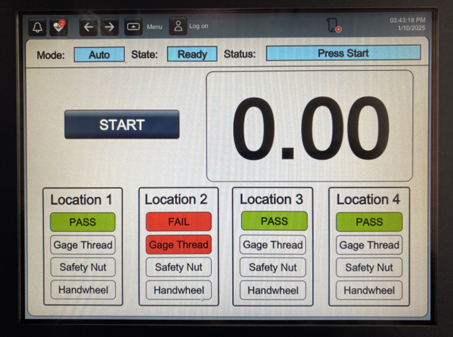
Finally, the team designed and delivered a detailed prototype cell proposal including: a design for a fully automated testing station with a PLC, HMI, collaborative robot, AI Vision, and KPI dashboards driven by work order data. The concept includes part rejection and sorting features, and is built to scale — all while demonstrating the ability to interface with MSA’s existing systems.
Impact
This collaboration provided MSA with more than just a proof of concept — it delivered a clear, de-risked path toward smart automation.
- The bench-scale demonstration validated that cobots could handle the leak test’s physical workflow safely and consistently.
- AI Vision showed strong potential to automate leak detection, providing the basis for greater quality control standardization, real-time data, and automated record keeping.
- The proposed pilot cell gave MSA a tangible next step for investment, including product specs, system architecture, and implementation guidance.
By grounding the project in real operational needs and using MSA’s own data and equipment, the Digital Foundry ensured the solution was not only innovative — but also practical, scalable, and aligned with business goals. Together, MSA and the Foundry laid the groundwork for a safer, smarter, and more productive future in quality performance testing.
“Partnering with the Digital Foundry to discover and pilot this new technology allowed the team to collaborate at the frontier of knowledge, where real industry experience and technical knowledge came together to implement a scalable solution that has real impact in our factory. By working with the Digital Foundry, the team was able to pilot different methods, learn fast, and continue to evolve the solution to get the right tech stack to solve our problem.”
–Jennifer Nemeth, Director, Global Advanced Manufacturing & Industrialization, MSA